Sunday, September 11, 2022

Exploring The White Mountains of New Hampshire

New England Fall Foliage Trip 2021

September 25-October 1, 2021

New Hampshire continued to provide us with scenes we had imagined for fall foliage in New England: covered bridges, babbling brooks, pastures of sheep, and breathtaking landscapes of gold, orange, and red.

Distant ski mountain, a swath of colorful foliage, trees and shed in foreground, and Robert Frost's mailbox in lower right.

The view from the porch of The Frost Place.


We visited The Frost Place in Franconia. Robert Frost retreated to this mountain home to escape allergies he suffered at lower elevations. Here he wandered through the woods and planted a small apple orchard. The museum was closed because of COVID, but visitors were welcome to walk the trails and sit on the front porch. I saw Frost’s wooden laptop writing desk through the window and pictured him sitting there, working on his poems.


Sign The Frost Place Museum and Poetry Center and The Frost Place house in a lawn with green grass surrounded by trees.

The Frost Place welcomes visitors even when no one else is there.


Without directions, one would hardly know this was a special place at all. Parking was questionable along the narrow gravel road. We noticed an empty lot on the right just before the house and surmised we should park there. We walked the trail through the woods behind the house and read the poetry boards posted along the way. We sat on the porch and admired the view. Previous guests had left gifts of poetry on the porch.

Rusty mailbox with R. Frost hand-painted in black print.

Robert Frost was most comfortable in the country.


During shoulder season, the campgrounds around Franconia Notch were still quite full, and we spent our first two nights at the Twin Mountain / Mt. Washington KOA, a well-organized place with many amenities. Like many RV parks, the sites were lined up right next to each other with little privacy. But we didn’t mind. Everyone was friendly. A staff person came by in a golf cart now and then and asked if we needed anything. He delivered firewood and picked up our trash. We did laundry, watched football in the TV lounge, and had a fire at our site.

Red maple leaf with purple veins on the ground.

A future watercolor project.


Although we prefer the naturalized settings of national and state park campgrounds, we enjoy the variety of other campground styles. The KOA is an excellent place for families with many activities children (young & old) would enjoy. I’m sure it’s an active place in the height of summer.

Blue sky, white puffy clouds, colorful distant mountains, green trees in foreground.

Starting to see the aurora of the forest.


We met a couple from Alaska who traveled in a posh camper van. We also witnessed a young family next to us locked out of their RV after a day of site-seeing. It was stressful to watch them attempting to rescue their dog trapped inside. It reminded me to always have my van key in my pocket, even just to go to the bathroom. We also have a hidden key. Redundancy is good.

Bright red covered bridge on right. Rocky brook in the tree on left.

New Hampshire is known for its covered bridges.


Our first outing was to Franconia Notch State Park. A notch is a deep, narrow mountain pass, and the park goes along the notch with scenic pullouts and trailheads along the drive. New Hampshire has many notches.

Hiking trail through the woods.

The Flume Gorge Trail at Franconia Notch State Park.


We hiked the Flume Gorge Trail, one of the most popular sites in the park. A gorge is “a narrow valley between hills or mountains, typically with steep rocky walls and a stream running through it.” During the high season, the park requires reservations to manage the number of people on the trail. We got tickets the same day.

Water flowing over large boulders. Boardwalk trail going around the boulder.

The Flume Gorge Trail is a two-mile, one-way loop.

After the hike, we rode on the Franconia Notch Bike Path but didn’t get far because my chain jammed in the gears when trying to change gears while going uphill. Lesson learned. Change gears before you need the lower gear, not while struggling up the hill. I worked the chain in good, and Roger couldn’t unstick it. He rode his bike back to get the van. We abandoned the ride, and he fixed my bike on another day.

Big red barn on left. Golf cart tire tracks going uphill in grass on right.

The Mountain View Grand Golf Course has lots of ups and downs.


We relocated camp south to Dry River Campground at Crawford Notch State Park. We detoured slightly for a round of golf at Mountain View Grand Resort and Spa in Whitefield. This historic inn and golf course sits atop a mountain, and the steep greens took some getting used to—on your tee shot, aim uphill of your target. I lost a few balls when they rolled right off the fairway and into the woods.

Man just after teeing off on mountain top tee box, surrounded by colorful foliage.

We played two rounds at this nine-hole course initially built in 1900.


The campground was about half full, with mostly retired people like us traveling in vans and small RVs. A couple of men camped in the cabin next to us, and Roger learned that one of them knew one of Roger’s friends; just like other occupations, fish people tend to be connected somehow.

Pleasureway camper van in campsite with picnic table, two camp chairs.

Dry River Campground at Crawford Notch State Park.

The next day, we hiked eight miles—a grueling hike for us with many steep inclines. Yes, it’s White Mountains National Park. Mountains usually imply incline. I didn’t consider elevation gain before starting our hike. I learned through experience. Our hike took us on a loop, beginning and ending at the campground.

Man standing on a boulder and taking a picture of a waterfall.

Our trail route: Bemis Brook > Arethusa-Ripley Falls > Webster Cliff > Saco River > Dry River Campground. This photo is of Bemis Falls. 


We reached a beautiful waterfall at what we thought was close to the trail’s end. We must have looked haggard because a couple we met offered a ride back to camp, which was a short distance down the road. No, no, no, we insisted. We want to get back under our own power. Are you sure? Yes, we’re sure.

Man sitting on boulder with waterfall in the background.

The trail brought us down a steep embankment to the base of Ripley Falls before crossing Avalanche Brook.


The trail brought us to the highway, crossed the road, and back into the woods, where we continued to climb. How is it possible for a trail to always go up? We were another hour on the trail before we reached the campground. I couldn’t kick my shoes off fast enough. Yes, we were exhausted, but what a good exhaustion. A feeling of accomplishment.

Saco River Trail and Webster Cliff Trail signs, nailed to trees.

Trail signs can be confusing. I find you-are-here maps more helpful.


We packed camp the following day and headed to the Cog Railway for a more leisurely outing before driving to our final New Hampshire accommodation, The Whitney’s Inn, where we would treat ourselves to a romantic New England bed and breakfast, watch football, and take a break from the van.

Train and railroad tracks going up a colorful hill. Mountain obscured by clouds.

Quite touristy, but the Cog Railway to the top of Mt. Washington is worth a visit.


Our stay was a bit of a disappointment. The TV didn’t work at first. They eventually brought in a new TV, but the troubleshooting disrupted the romantic vibe. We expected the room to be small, but it was also poorly designed, with no place to put our stuff. There was one dresser that held the TV. It could have used a side table, desk, luggage rack, or hooks. The closet had just two or three hangers. Consequently, all of our stuff was spread out across the floor.

Man standing next the Whitney's Inn sign.

We took a two-night break from the van in Jackson, N.H.


One of the reasons I booked this place was for the on-site Shovel Handle Pub. After a day of traveling, we didn’t want to get back in the van to drive to a restaurant. After we arrived, we learned that the pub was not open that night. I checked the website, and there was no mention of the pub being closed part of the week. There were no nearby restaurants and no deliveries. Luckily, we had enough food in the van to feed us that night. Our room also did not have a coffee maker, which I overlooked until morning. I went to the dining room to retrieve coffee and learned that our room was the only room without a coffee maker. Why? The website also pictured an outdoor fire. There was a fire ring but no evening fire.

Woman sitting in bed with mud mask on face.

The spa at Whitney’s Inn. Kidding! Alaska Glacier Mud mask. Check them out.


The Inn had a few positive aspects: cookies at the front desk, a delicious breakfast for $10, dinner in the pub our second night, and that quintessential historic country inn decor. The inn borders a farm, and the dining room’s large picture windows overlook a horse pasture. Roger paddled the canoe in the small trout pond across the street. The inn caters to weddings and special events, and as an overnight guest (albeit staying in the least expensive room, but that shouldn’t matter), I felt we didn’t get the level of service I expected.

Red canoe on shore in front of small pond.

The inn advertises boating in its stocked trout pond.


The air was finally beginning to cool after a stretch of unseasonable warm weather, and the foliage gradually turned from subtle to glorious the closer we got to Maine.

Highway with Maine Welcome Home sign.

Not as dramatic as the Piscataqua River Bridge, but I’ll take it.


We crossed the border and looked for a place to reprovision in preparation for remote travel through western Maine. During our grocery stop in Bethel, we had what turned out to be our biggest mishap and the greatest experience of grace. See our Maine installment (coming soon!) to find out what happened.

Sheep grazing in a pasture with a red maple tree hanging over them

Where the sheep keep the lawn.


The Vantage Point

by Robert Frost

If tired of trees I seek again mankind,

Well I know where to hie me—in the dawn,

To a slope where the cattle keep the lawn.

There amid lolling juniper reclined,

Myself unseen, I see the white defined

Far off the homes of men, and farther still,

The graves of men on an opposing hill,

Living or dead, whichever are to mind.


And if by noon I have too much of these,

I have but to turn on my arm, and lo,

The sun-burned hillside sets my face aglow,

My breathing shakes the bluet like a breeze,

I smell the earth, I smell the bruised plant,

I look into the crater of the ant.


(Originally published in 1913 in Robert Frost’s first commercially published book of poetry, A Boy’s Will.) 


Our Route Through New Hampshire


Patricia E. Harding. © copyright 2022. All rights reserved.


Wednesday, July 13, 2022

Vermont: Fall Solstice in The Green Mountain State

New England Fall Foliage Road Trip 2021

Vermont
September 19-24, 2021

After a long break from traveling because of COVID, Roger and I returned to our older 19-foot Pleasureway camper van and completed a two-month fall foliage road trip through Vermont, New Hampshire, Maine, Massachusetts, New York, and Pennsylvania.

Woman and man standing in front of a camper van.
Ready to go! I remember how hot and muggy it was that day.

Some of you may be planning or just contemplating a fall foliage trip, so this is a good time to tell you about ours. I hope it inspires you to get out and explore and marvel at the beautiful colors of the natural world.


Our Starting Point: Midlothian, Virginia


Our trip started in Midlothian, Virginia, in early September where we participated in a family celebration for my stepfather’s 80th birthday. We retrieved the van from storage and brought it in for planned service for new tires, headlights, and an oil change. We unexpectedly added new brakes to the job which delayed our departure by two days. (For those of you new to this blog, see our March 2020 story about Going Home at the start of the COVID-19 pandemic.)


Another prep purchase was the Luggable Loo from Dick’s Sporting Goods. We wanted to have the flexibility to boondock. Yes, our van has a toilet and gray and black water holding tanks, but we prefer not to use it for #2. A Luggable Loo is a five-gallon bucket with a toilet seat, lined with a special bag for that purpose. When sealed properly, the bag can be disposed of in a regular trash can. We live in Alaska and know what it means to be remote. Going in a bucket is not new to us. But this will be our first bucket experience on the road.


Highway with cars, lined with green trees.
The foliage in northern Virginia was still quite green on September 17.

Finally, a few nights before we were to leave Virginia, I woke in the night and remembered toll roads! The East Coast has many tolls. The next day I went online and purchased a Uni Epass which works in most eastern states. It arrived quickly and was easy to set up and activate.

New Jersey turnpike with many cars.
I told Roger that this day of driving will be the worst of the whole trip, the DC-New York City corridor, and I was correct!

Our mooch trail to Vermont included our niece and her husband (and two sweet dogs, love you Louie and Archer!) in Dumfries, Virginia. We also stopped for a night at the home of a close college friend and her family in Washington Township, New Jersey. They treated us to New Jersey bagels, the best because of the hard water. From there, we drove north along the Hudson River and the New York and Vermont border.


Distant view of New York City.
Roger seeing NYC for the first time—even from a distance—was like when I first saw the Golden Gate Bridge in San Francisco. Iconic images that once seemed like fairy tales become real.


Leg 1: Washington Township, NJ > Bennington, Vermont & Woodford State Park (278 miles, ~5 hours)


Map of route from New Jersey to Bennington, Vermont.

The drive on U.S. Highway 7 North to Bennington was comfortable and scenic. We had a bluebird day, and I gazed out the window as we left the flatlands of New Jersey and entered the mountainous landscape to the north, including the Hudson Highlands and Taconics, as well as the Berkshires to our east and the Catskills to our west.


We drove through Woodbury, Kingston, and Albany before crossing the Hudson and entering Vermont. As soon as we crossed the state line, we saw nothing but mountains and trees in the distance. The colors were just beginning to turn. Not sure what we’d find for stores down the road, we filled the tank and bought groceries to last the next few days.


Picnic table on the shore of a blue lake lined with trees..
Woodford State Park, Woodford, Vermont

Vermont is just as we imagined. Rolling hills of fresh-cut hay, red barns, and the faint scent of manure in the air. Quaint without trying to be quaint. We appreciated the lack of strip malls and urban retail sprawl. We drove from small town to small town without a single Walmart in sight. It reminded me of Germany where regulations require green space between towns and cities.

Blue lake and beach. Three small boats on the beach.
Just starting to see tinges of color.

To make up for the two days we lost for the brake job, we skipped our planned visit to downtown Bennington and drove directly to Woodford State Park Campground where we settled in for two nights.


Reservoir lake with lily pads floating in the water. The water is reflecting the blue sky.
Adams Reservoir, Woodford State Park, Woodford, Vermont
Woodford State Park covers 398 acres surrounding Adams Reservoir on a mountain plateau 2,400 feet in elevation and borders 14,000 acres of the Green Mountain National Forest. We stayed in site #85 in the newer area of the campground and near the bathrooms and showers. The campground was only partially full, and we had plenty of space and privacy.

Campervan parked in camp site, surrounded by many green trees.
Site #85, Woodford State Park, Woodford, Vermont

During our full day in the park, we hiked the 2.7-mile Reservoir Loop Trail around the reservoir and then relaxed by a campfire in the evening. 


Hiking trail with lots of mud and tree roots.
The Reservoir Loop Trail reminded me of Juneau—muddy and rooty in spots.


Leg 2: Woodford State Park > Middlebury, Vermont (97 miles, ~2 hours)


Map showing route from Bennington to Burlington via Middlebury.

We got an early start at 9 a.m. (early for us) and headed north again on U.S. Highway 7. We stopped at Brandon RV and bought a new freshwater pump and an outdoor shower kit. (Reminder, we live in Juneau, Alaska, and keep the van in storage down south when we’re not traveling, so the only time we have to do projects is when we’re traveling.)


In Middlebury, we stopped at Rosie’s Restaurant for lunch where I ordered a Reuben and Roger got tomato soup and the turkey salad wrap special. Rosie’s is one of those comfort food diners where locals eat. The kind of place we like. We also ordered a salad and a piece of chocolate cream pie to-go for later.


We dropped in at the Ralph Myhre Golf Course, an 18-hole public course at Middlebury College, and luckily for us, they were able to fit us in for nine holes. It's hard to schedule a tee time when you're on the road. The fairways were more narrow than what we’re used to and the greens were often elevated, so we had to be careful and play our short game or our balls would roll off the back of the green. Regardless of what our scores say, we enjoyed the exercise on a beautifully warm, sunny, autumn day.


Man putting on golf course green. Blue sky.
Ralph Myhre Golf Course, Middlebury College, Middlebury, Vermont


Leg 3: Middlebury > Burlington, Vermont & North Beach Campground (37 miles, ~1 hour)


After golf, we drove to Burlington, a bigger city than I had imagined, with narrow streets and tight turns for a camper van. We made our way through the city thanks to Google Maps and found site #95 at the North Beach Campground, a municipally-owned campground on Lake Champlain popular with bicyclists for its proximity to the Island Line Trail which we biked the next day.

Campervan at spacious campsite.
Site #95, North Beach Campground in Burlington, Vermont.
When we booked online, only three spots were available. Our corner site turned out to be a prime spot. Many other sites were side-by-side, with little distance between them, but we had plenty of space.

Beach at Lake Champlain. Blue sky with white clouds.
Lake Champlain, Burlington, Vermont
The campground is next to a section of the Island Line Trail that runs along the 490-square-mile freshwater lake. This is the kind of campsite we like. We can get around with our bikes and feet without having to drive. When you live on the road, it’s sometimes a hassle to have to drive again once you get to where you’re going. As its name implies, beach access is just a short walk or bike ride from the campground.

Woman riding bike on paved, tree-lined bike path.
The Island Line Trail, Burlington, Vermont
On our free day (non-driving day), we biked 17 miles from the campground to the Colchester Causeway that stretches into Lake Champlain.

Man biking on causeway in Lake Champlain.
Colchester Causeway, Colchester, Vermont
After riding all day, we were too tired to walk, so we rode again in the opposite direction to Foam Brewery for beers, then to Citizen Cider for dinner. Walking is totally doable if going to town for the day. We were glad we had bikes and made it back to the campground just as it was getting dark.

Leg 4: Burlington > Elmore, Vermont, & Elmore State Park (51 miles, ~1.25 hours)


Man and woman holding up their ice cream cones.
Ice cream for lunch!
Our stomachs guided us to our next destination > Ben & Jerry’s Ice Cream Factory of course! Then to the Cabot Farmers' Store , both in Waterbury. We had ice cream for lunch and Vermont cheese, apples, wine, and cider for happy hour.

Plate of apple, cheese and crackers, bottle of wine, and Robert Frost book.
Eating, drinking, and reading our way through Vermont.
Food is a good theme to guide anyone traveling through Vermont. If you are interested in food and sustainability, I recommend reading (or listening on audio as I did) The Town That Food Saved: How One Community Found Vitality in Local Food (2010) by Ben Hewitt . The book taught me about the concept of eating closest to the sun, which means not only eating more greens that get energy directly from the sun, but also eating food from where you live, versus something that was shipped to you or, worse yet, food that was processed and packaged in a factory far, far away. Hewitt was born and raised in Vermont and has his own farm. Through a series of interviews in and around the town of Hartwick, Vermont, Hewitt reveals the economy, complexities, politics, and humanity of the local food movement.

Landscape of colorful field and mountains.
Vermont landscape, September 2021.
Elmore State Park, situated on the shore of Lake Elmore and at the base of Elmore Mountain (elev. 2,608 feet), is a quiet and peaceful park. The weather was still quite warm that day, and I was tempted to jump in the lake to cool off. We took advantage of this stop on the road to rest and catch up on some reading.

Red foliage of a tree against the blue sky.
Bring on the color!
I was reading Robert Frost A Life by Jay Parini. Frost lived in Vermont for about 40 years and became its poet laureate in 1961. Another good Frost/Vermont resource is a 1991 New York Times article by Robert D. Kaplan, “Robert Frost’s Vermont.”

Man sitting at fire at a campsite with campervan .
Elmore State Park Campground has spacious sites with plenty of trees and shrubs for privacy.

If all you’ve ever seen of Vermont is from television or literature, it’s fairly accurate—rolling hills, countryside, farms, small college towns, and friendly people. Our camp neighbors at Elmore were Sam Billings, a violin maker, and his girlfriend and dog. They traveled together, and Sam had a complete workshop in the back of his camper van.

Red, orange, and yellow leaves on the green grass.
Fall leaves meet green summer grass.
John Irving is one of Roger’s favorite authors. (The World According to Garp, Cider House Rules, Last Night in Twisted River.) Many of Irving’s novels take place in New England.


A field of corn brown cut corn stalks in the foreground. Mountains in the background. Blue sky and white clouds.
After the corn is cut.

“Being from California, it was always hard for me to imagine when John Irving wrote about being a professor in a small college town. California doesn’t have small college towns. But being here, you can really see it.”


A bee on an aster flower.
A busy bee photobombs the asters.

I have a long list of Vermont places I had researched and hoped to visit, but we just didn’t have enough time (remember, we had to cut two days from our trip because of the brake job), and some places were still closed because of the COVID pandemic. When you go, you might also consider visiting: the Southern Vermont Arts Center (SVAC); Billings Farm & Museum for ice cream; Sugarbush Farm for maple syrup, cheese, and walking; and Shelburne Craft School.


We left Vermont, and our first stop in New Hampshire was Robert Frost’s home in The White Mountains. Stay tuned for more about New Hampshire in the next article.


An orange catepillar with black stripes on its back crawling on a rock.

Meeting and Passing

By Robert Frost


(From The Collected Poems of Robert Frost, 1930)


As I went down the hill along the wall

There was a gate I had leaned at for the view

And had just turned from when I first saw you

As you came up the hill. We met. But all

We did that day was mingle great and small

Footprints in summer dust as if we drew

The figure of our being less than two

But more than one as yet. Your parasol


Pointed the decimal off with one deep thrust.

And all the time we talked you seemed to see

Something down there to smile at in the dust

(Oh, it was without prejudice to me!)

Afterward I went past what you had passed

Before we met and you what I had passed.


A bunch of red berries from a tree.

© copyright 2022. Patricia E. Harding. All rights reserved.


Wednesday, January 19, 2022

A Freezing Fun Time at Fur Rondy in Anchorage, Alaska

Photo of people standing in front of the auction stage.
In 2019, Roger and I attended the annual winter festival in Anchorage, Alaska, known as Fur Rondy.

February 23-24, 2019

Our friend, Troy, was hiking when his friend whispered, “Stop.” Instinctively, Troy knew that his friend had seen a bear. Not just any bear, but a Southeast Alaska Island brown bear. Brown bears in Southeast Alaska and Kodiak are grizzly bears but are generally bigger than grizzlies found in the interior of Alaska and the lower 48. The brown bears typically grow larger because of the prevalence of protein-rich salmon in their diets. Troy was alert and prepared because he knew that only brown bears inhabited the island where they were hiking.

Through the trees, the friend saw just the hump of a brown bear’s back across the top of a tree hollow. The bear had been sleeping. Troy chambered a round in his rifle just as the bear rose from behind the tree. The aggravated bear looked up the trail; it looked down the trail, homed in on the two men, lowered its head, and charged.

Photo of a brown bear paw. About four times larger than a man's hand.
An Alaska brown bear paw.

Troy dropped to one knee, aimed, and pulled the trigger. He had only seconds to react. The bear was a mere twenty feet away. Fortunately, he had good aim. The bullet went through the bear’s neck and down its artery, dropping it immediately.

We ran into Troy at the 2019 State of Alaska Hide and Horn auction, part of the annual Fur Rendezvous held in Anchorage. Fur Rondy or just Rondy, began in 1935 when Anchorage had just 3,000 residents. The first winter festival was scheduled when miners and trappers usually came to town to sell their bounty. Today, the festival celebrates history and culture, provides entertainment, and attracts tourism.

While nearly all bears in Alaska are harvested by legal hunting, regulations allow a person to kill a bear in “defense of life or property.” However, the person may not keep the bear and must file a report and surrender the bear’s skull and hide to the Alaska Department of Fish and Game. In Troy’s case, he and his friend had to stop what they were doing, remove the hide and skull of the bear, and deliver them to ADFG. Not an easy task. According to ADFG, a brown bear hide can weigh 100 pounds, and the skull can add another 25 pounds.

Troy was hoping to reunite with the bear he had killed—well, with the hide of the bear anyway.
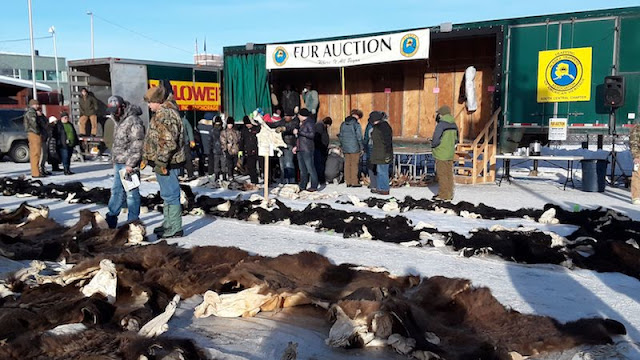
Photo of brown and black bear hides spread out on the ground in front of the auction stage.
Auction goers preview brown and black bear hides at the annual Hide and Horn Auction.

Anticipating that the hide from the bear he killed would be at the Hide and Horn Auction, Troy flew to Anchorage, intending to bring it home. ADFG does not track the hides, and Troy identified the one he had shot among the more than 100 hides by using photos he had taken of identifying marks on the paws, the location of the bullet hole in the neck, as well as the color and size of the hide. Other bidders were also interested in this hide because of its condition, size, and dense hair. Ultimately his high bid of over $800 was accepted, and he was declared the winning bidder and was awarded the bear hide.

Once a year, ADFG sends hides from defense-of-life-and-property kills, such as Troy’s, as well as others from roadkill and those that have been confiscated from poachers or other illegal hunters to Anchorage, where the South Central Chapter of the Alaska Trappers Association organizes a fur auction.

Roger and I flew from Juneau to Anchorage for a long weekend, arriving in time for the Fireworks Extravaganza on Saturday night. The following day, we went to the fur auction as onlookers, where we ran into Troy, and he told us his bear story.


Photo of a white Dall's Sheep cape.
A Dall’s sheep cape is ready for auction. According to the National Park Service, “Dall’s sheep inhabit some of Alaska’s most rugged alpine areas.”

The auction also sold caribou and moose antlers, and sheep horns. A set of muskox horns went for $1,000. River otter hides went for between $50 and $100 or more. Black bear hides sold for hundreds of dollars, depending on the size and quality. Brown bear hides sold for more. The highest bid was $3,300 for a brown bear hide. Cub hides were popular too and went for between $500 and $700 apiece.


This auction is the only opportunity for people to legally purchase animal hides in Alaska and attracts collectors worldwide. This auction benefits wildlife, hunting, and education programs of both ADFG and the Alaska Trappers Association.

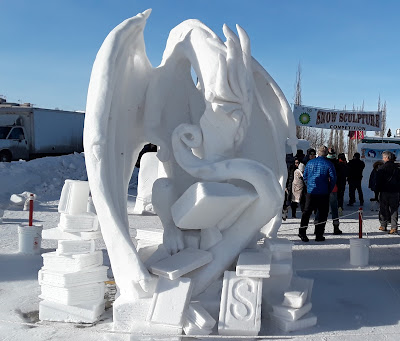
Photo of a snow sculpture of a dragon sitting among a pile of books.
“Not All Treasures Are Gold” carved by AK Awesome.
The auction moved slowly, so we broke away to visit the State Snow Sculpture Championship, which was a short walk from the auction area. We returned to the auction, then left again to watch the start of the Open World Championship Sled Dog Races. The fastest sled dogs on earth race 25 miles through the streets of Anchorage. We ate reindeer hotdogs topped with grilled onions, sauerkraut, and mustard from a food vendor. So good!

During our final visit to the auction, we witnessed Troy’s successful bid on the hide, waited for him to claim it after the end of the auction, and helped him get it into his truck. (FYI—not only are bear hides heavy, they also stink!) Troy already had a taxidermist lined up to process the hide, so we quickly said our goodbyes, and he was on his way.

Don’t let the cold Alaska winter keep you from attending Fur Rondy. You can enjoy outdoor winter activities when you dress appropriately for the conditions. If you have real animal fur garments, Anchorage is the place to wear them. Fur Rondy is one of the few places where it is still acceptable to wear animal fur.


Photo of the Rondy Royalty, all dressed in fur, on the auction stage.
Rondy Royalty 2019

Fur Rondy 2022 is scheduled for February 25-March 6. Planned events include the Alaska Cornhole Championship, Alaska Hold ’em Tournament, a Native Arts Market, traditional snow sculptures, fur auction, and fireworks. For a complete list of events and additional information about Fur Rondy, visit the Rondy website at https://www.furrondy.net/.

NOTES: Thank you, Troy, for permission to include your bear story in this article. Every day I am thankful for my husband, travel partner, editor, and proofreader, Roger.