Showing posts with label Alaska. Show all posts

Friday, October 10, 2025

Leaving Juneau

The September Exodus: Fall Travel 2025


September 15, 2025

September is a good time to leave Juneau. The wood shed and freezers are full. The garden is put to bed. Next year's garlic is planted. Rain has returned. Wet, dark, gloomy, cold, windy rain.
A band of bright pink fireweed blossoms against a gray sky and browning meadow.
Fireweed blossoms tell us the end of summer is near.

The two times a falling tree narrowly missed our roof were during a September storm. The first time, we went to Aurora Harbor to check on our boat. The storm was bad, and the harbor master posted photos on Facebook of half-sunken vessels. Please check your boats, the post said.

The Dawntreader was fine, but when we arrived home, a strange site took us a few minutes to decipher. A tree lay between us in the driveway and our front door. It was a bizarre experience to see a tree where one wasn't supposed to be. So strange, we just about walked into it before realizing it was there. Which would have been impossible because it was a large spruce tree with many branches, some of which had plunged into the earth like King Arthur's sword in the stone.

When we eventually realized what we were seeing, Roger and I looked at each other without speaking. Our expressions said it all, “WTF?”

The second tree that nearly destroyed our house.

In the hour and a half while we were gone, a tree in the back yard had fallen, grazing the side of our house and pulling off the utility connections. To get in, we had to walk down the road and approach the front door from our neighbor's driveway.

Roger, my logistical hero, was immediately on the phone with tree cutters and utility companies, intuitively knowing they would be in high demand in the coming hours during this intense rain and windstorm. In a relatively short amount of time, our entryway was cleared, power was restored, and the fish we had spent the summer catching and processing were safe in the freezer, alongside frozen bags of salmonberries, blueberries, and rhubarb.

Salmonberries turn ruby red as they ripen.
The following year, while we were golfing at Lakewood in Skowhegan, Maine, our phones blew up with messages from home. Another tree had fallen, during another September storm, in the exact same spot as the year before. When the root systems of these massive trees are disturbed, their viability is compromised. So when one tree falls, you can expect others in the same area to also fall.

Thanks to our experience from the year before, Roger immediately got on the phone and called for help from a nearby tree cutter and the utility companies. A relative helped cut up the tree until he reached a diameter too large for his chainsaw. Later that night, the tree, relieved of the weight of its branches and top section, sprang back up into its vertical position, flinging off the partially cut round that had missed hitting a car, person, or house when it landed in our neighbor's driveway. Earlier that day, our neighbor's children had been playing in the gravel root hole the fallen tree had exposed. We shudder to think what could have happened if the tree had popped back up during the daytime.

The storm on Engineer's Cutoff and Mendenhall Peninsula that year (2022?) was called a microburst. It was as if a mini tornado had whipped through the area, ripping and toppling trees, one after another, like dominoes. Our neighbors, who had retreated to the safety of their boat in the marina, sent us a video of our unrecognizable neighborhood.

Trees flagged to be cut and the remains of the fallen one on the ground.

The following summer, we partnered with the same neighbor to hire a tree cutter to cut down the remaining threatening trees.

Now, we can leave Juneau in relative peace, with the help of friends and family who house sit and water plants, knowing that, of all the things that could happen to our home while we are gone, a tree falling on it is probably not one of them.

Our Alaska Airlines flight lifted away from Juneau. The airport, the wetlands, Lemon Creek, and Twin Lakes receded from view as we reached bird's eye level with Mount Juneau and Mount Roberts. I glanced toward Perseverance Trail and looked toward Granite Creek Basin, an area I hiked during the COVID summer.

Snow-dusted mountain looming behind downtown Juneau.
Mount Juneau view from the Dawntreader on a summer day.

Soon we were above the peaks, bare of snow, looking for the white dots that might be mountain goats grazing in the mid-September alpine pastures. We will miss the first signs of winter, a coating of termination dust that looks like confectionery sugar across the mountain peaks.

Just like clockwork, September reared her ugly head as we were landing on the East Coast. “The weather is terrible,” our friends texted us. “High gusts downtown. Messing with cruise ships. Some can't leave, and a couple can't get in and have cancelled their Juneau stop.” The National Weather Service warned of 60 mph gale-force winds and flooding. Heavy rainfall could cause landslides as saturated mountainsides can't hold back soil and trees.

We turned our rental car north on Route 1 to Maine with a big blue sky and warm sun overhead, beckoning us forward. Ah! September in Maine. The way life should be.

© Copyright 2025. Patricia E. Harding. All rights reserved.
Updated 11/20/2025.

Wednesday, January 19, 2022

A Freezing Fun Time at Fur Rondy in Anchorage, Alaska

Photo of people standing in front of the auction stage.
In 2019, Roger and I attended the annual winter festival in Anchorage, Alaska, known as Fur Rondy.

February 23-24, 2019

Our friend, Troy, was hiking when his friend whispered, “Stop.” Instinctively, Troy knew that his friend had seen a bear. Not just any bear, but a Southeast Alaska Island brown bear. Brown bears in Southeast Alaska and Kodiak are grizzly bears but are generally bigger than grizzlies found in the interior of Alaska and the lower 48. The brown bears typically grow larger because of the prevalence of protein-rich salmon in their diets. Troy was alert and prepared because he knew that only brown bears inhabited the island where they were hiking.

Through the trees, the friend saw just the hump of a brown bear’s back across the top of a tree hollow. The bear had been sleeping. Troy chambered a round in his rifle just as the bear rose from behind the tree. The aggravated bear looked up the trail; it looked down the trail, homed in on the two men, lowered its head, and charged.

Photo of a brown bear paw. About four times larger than a man's hand.
An Alaska brown bear paw.

Troy dropped to one knee, aimed, and pulled the trigger. He had only seconds to react. The bear was a mere twenty feet away. Fortunately, he had good aim. The bullet went through the bear’s neck and down its artery, dropping it immediately.

We ran into Troy at the 2019 State of Alaska Hide and Horn auction, part of the annual Fur Rendezvous held in Anchorage. Fur Rondy or just Rondy, began in 1935 when Anchorage had just 3,000 residents. The first winter festival was scheduled when miners and trappers usually came to town to sell their bounty. Today, the festival celebrates history and culture, provides entertainment, and attracts tourism.

While nearly all bears in Alaska are harvested by legal hunting, regulations allow a person to kill a bear in “defense of life or property.” However, the person may not keep the bear and must file a report and surrender the bear’s skull and hide to the Alaska Department of Fish and Game. In Troy’s case, he and his friend had to stop what they were doing, remove the hide and skull of the bear, and deliver them to ADFG. Not an easy task. According to ADFG, a brown bear hide can weigh 100 pounds, and the skull can add another 25 pounds.

Troy was hoping to reunite with the bear he had killed—well, with the hide of the bear anyway.
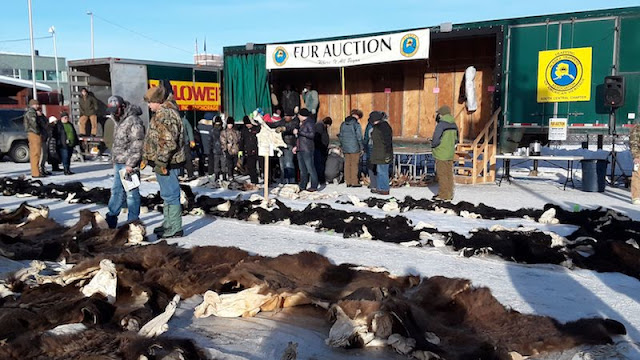
Photo of brown and black bear hides spread out on the ground in front of the auction stage.
Auction goers preview brown and black bear hides at the annual Hide and Horn Auction.

Anticipating that the hide from the bear he killed would be at the Hide and Horn Auction, Troy flew to Anchorage, intending to bring it home. ADFG does not track the hides, and Troy identified the one he had shot among the more than 100 hides by using photos he had taken of identifying marks on the paws, the location of the bullet hole in the neck, as well as the color and size of the hide. Other bidders were also interested in this hide because of its condition, size, and dense hair. Ultimately his high bid of over $800 was accepted, and he was declared the winning bidder and was awarded the bear hide.

Once a year, ADFG sends hides from defense-of-life-and-property kills, such as Troy’s, as well as others from roadkill and those that have been confiscated from poachers or other illegal hunters to Anchorage, where the South Central Chapter of the Alaska Trappers Association organizes a fur auction.

Roger and I flew from Juneau to Anchorage for a long weekend, arriving in time for the Fireworks Extravaganza on Saturday night. The following day, we went to the fur auction as onlookers, where we ran into Troy, and he told us his bear story.


Photo of a white Dall's Sheep cape.
A Dall’s sheep cape is ready for auction. According to the National Park Service, “Dall’s sheep inhabit some of Alaska’s most rugged alpine areas.”

The auction also sold caribou and moose antlers, and sheep horns. A set of muskox horns went for $1,000. River otter hides went for between $50 and $100 or more. Black bear hides sold for hundreds of dollars, depending on the size and quality. Brown bear hides sold for more. The highest bid was $3,300 for a brown bear hide. Cub hides were popular too and went for between $500 and $700 apiece.


This auction is the only opportunity for people to legally purchase animal hides in Alaska and attracts collectors worldwide. This auction benefits wildlife, hunting, and education programs of both ADFG and the Alaska Trappers Association.

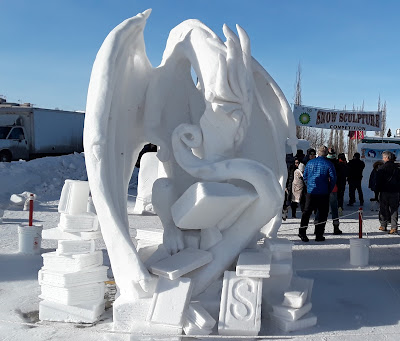
Photo of a snow sculpture of a dragon sitting among a pile of books.
“Not All Treasures Are Gold” carved by AK Awesome.
The auction moved slowly, so we broke away to visit the State Snow Sculpture Championship, which was a short walk from the auction area. We returned to the auction, then left again to watch the start of the Open World Championship Sled Dog Races. The fastest sled dogs on earth race 25 miles through the streets of Anchorage. We ate reindeer hotdogs topped with grilled onions, sauerkraut, and mustard from a food vendor. So good!

During our final visit to the auction, we witnessed Troy’s successful bid on the hide, waited for him to claim it after the end of the auction, and helped him get it into his truck. (FYI—not only are bear hides heavy, they also stink!) Troy already had a taxidermist lined up to process the hide, so we quickly said our goodbyes, and he was on his way.

Don’t let the cold Alaska winter keep you from attending Fur Rondy. You can enjoy outdoor winter activities when you dress appropriately for the conditions. If you have real animal fur garments, Anchorage is the place to wear them. Fur Rondy is one of the few places where it is still acceptable to wear animal fur.


Photo of the Rondy Royalty, all dressed in fur, on the auction stage.
Rondy Royalty 2019

Fur Rondy 2022 is scheduled for February 25-March 6. Planned events include the Alaska Cornhole Championship, Alaska Hold ’em Tournament, a Native Arts Market, traditional snow sculptures, fur auction, and fireworks. For a complete list of events and additional information about Fur Rondy, visit the Rondy website at https://www.furrondy.net/.

NOTES: Thank you, Troy, for permission to include your bear story in this article. Every day I am thankful for my husband, travel partner, editor, and proofreader, Roger.

Thursday, November 12, 2020

Road Trip 2020: Virginia & Going Home

Virginia & Going Home

March 7-17, 2020

A toast to celebrate our successful and eventful Winter Road Trip 2020.

Our niece’s March 7 wedding in Virginia Beach was the inspiration for our Winter 2020 cross-country road trip. We left Juneau on January 7, 2020, and picked up our camper van stored in Sacramento. All our adventures from California to Virginia naturally fell into place—a family visit in Palm Springs, a college roommate reunion in Las Vegas, a family reunion in Mississippi, and several wonderful visits with longtime friends.

We left Juneau on January 7 and drove across the country in two months.

A road trip like this required planning, but we couldn’t have anticipated every scenario. (See the Blog Archive for posts of previous legs of our journey.)

The Wedding

On March 6, we left the Outer Banks National Seashore in North Carolina and drove north to Virginia Beach. We looked forward to visiting family and friends as well as celebrating my niece’s wedding.


We visited with many dogs on this trip. My niece's dogs were snugglers.

When relatives live across the United States, a wedding also serves as a de facto family reunion. We stayed in Virginia Beach three nights and enjoyed Sunday dinner with my dearest friend since seventh grade before departing for my mother’s house in Midlothian.
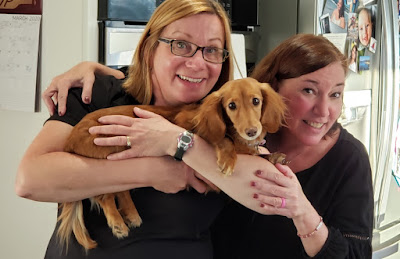

My friend Bonnie's dog, Willow, was lovable too.
Midlothian

The plan was for me to visit my mother and step-father for three weeks before flying to Maine to see my son during his spring break. Roger was to fly to the West Coast ahead of me to attend a meeting and visit his children. That was the plan as of March 9. Two days later, everything changed.


Coronavirus, cancellations, and changes

COVID-19 was spreading fast, and events across the country were being canceled. As of March 9, the United States had experienced 26 deaths caused by COVID-19, and there’d been 4,000 deaths worldwide. (See Notes 1) By March 11, Washington state, San Francisco, and Oakland announced size limits on large gatherings.


Good morning from Midlothian, Virginia! Our final destination.

Our concerns quickly shifted from, “Do we cancel our plans?” to “Can we get home before the whole country shuts down?” As chairman of the planning committee, Roger had been in regular contact with meeting planners. After much back and forth, they decided to cancel their meeting.

Feeling spoiled at Mom's house.

I spent two days agonizing over what to do. I would make up my mind to go to Maine in one moment only to change it a few hours later. I went back and forth several times until bedtime on the evening of Thursday, March 12. Final decision. I would go home with Roger. By then, the NBA, NHL, and NSL had all suspended their seasons. The NCAA canceled championship basketball tournaments, followed by Major League Baseball canceling spring training games. What seemed like a choice just two days earlier—should I stay or should I go?— became an imperative—we must get home to Juneau, together, as soon as possible.

I inherited my love of food and cooking
from my mother. She treated us to our favorites.

We spent most of the day on Friday, March 13, (Yes, Friday the 13th!) online, changing our flight plans. Most airlines waived rescheduling fees, but we had to reschedule all our flights online. The airlines would only accept phone calls from people in emergency situations or whose flights were scheduled in the next 48 hours. One of the biggest mistakes we made was rerouting our flights through Boston. Why I thought we had to fly via Boston, I can’t tell you. We could have flown to Seattle directly from D.C.

After securing new flight plans, we spent the rest of the weekend preparing the van for storage. Storing the van in Virginia had been our plan all along. We wanted to stage it for our next few trips exploring the East Coast. We found a storage yard less than five minutes from my mother’s house in Midlothian. We left the sleeping bags with my mother, who would take them to the cleaner. I also left her with several boxes to ship to Juneau. We put the bikes and the bike rack inside the van and placed an open container of mothballs inside to ward off critters looking for a new home.


Virginia was the end of the road for this trip, and the van went into storage.

Saying goodbye to the van was bittersweet. Our van is like our home. It’s hard to say goodbye when you don’t know when you’ll see each other again.

Flying Home

We flew out of Richmond to Boston via Washington, D.C., on Monday, March 16, wiping every surface with Clorox wipes we swiped from the van.


Carlsbad, the Year of the Rat mascot
we found in Carlsbad, New Mexico,
is ready to fly to his new home in Juneau.

Our flight from Boston to Seattle got delayed, delayed, delayed, then finally canceled. It seemed like the only people at the airport were our cohort of passengers trying to get to the West Coast. I felt sad for the many college students traveling home for spring break. Schools told them to take everything with them as if they would not be returning. Boston is home to several music schools. Many of the students carried instruments in addition to their large suitcases full of their belongings. College classes and K-12 schools across the country would move online or be canceled for the rest of the semester.

Earlier in the day, when one of the Boston delays would make us miss our connection in Seattle to Juneau, we had to stand in a long line to rebook our next flight. I volunteered. Some people wore masks. My step-father had given us masks before we left the house that morning, but we did not wear them. In retrospect, it was probably a dumber mistake than flying through Boston. I don’t know why we didn’t wear them. I guess we were still naive about the seriousness of the situation. But in fairness, the public messaging at the time was that a mask would only help those already infected from spreading the virus and would not protect people from being infected. Public messaging in the early days of the pandemic also discouraged using N-95 masks because healthcare facilities were experiencing an N-95 mask shortage. The N-95 mask was believed to offer the best protection, and homemade cloth masks had not caught on yet.

The gate area at Richmond International Airport was eerily empty on the morning of March 16, 2020.

We’ve never seen so few people
at Logan International Airport in Boston.

Eventually, Alaska Airlines canceled our flight to Seattle at around 10:00 p.m., and we had to stand in another long line to rebook. We left the gate area with some of the other passengers and got in line at the Alaska Airlines desk downstairs. While waiting in that line, I overheard a woman on the phone. She was desperate to help her daughter get home from Ecuador.

She was not part of our group. She came to the airport, thinking she could get answers if she was there in person. Her daughter had been visiting the Galapagos Islands when the Ecuadorian government abruptly canceled all flights in and out of Ecuador. The woman was calling every U.S. government and airline official she could think of with 
no success. I heard her say to a government official on the phone, “You’re just reading to me what’s on the website. I already read that myself. That information is not up to date. They’re not letting any flights out. Is there anything else you can do?”

By now, many of us felt helpless with the situation.

We had time to appreciate Chris Williams’s “Seascape” installation during our many hours of waiting at Logan's Terminal B. 


Alaska Airlines provided hotel and food vouchers for all the passengers on our canceled flight. They sent an email link with a list of options, and we chose a hotel—a nice hotel in Chelsea. Then we had to retrieve all our luggage and schlep it to a shuttle bus to the hotel. Again, these poor college students with all their luggage. While in line (again) at the hotel, a young man ahead of us had large suitcases and loads of ski gear. He was a competitive collegiate skier, and the rest of the season had been canceled. He was trying to get home to Anchorage. When he got his turn at the check-in counter, he learned he had gone to the wrong hotel. Poor kid. He had to drag everything back outside and find a ride to his hotel.

Around midnight, we checked in, and I mentioned to the man at the front desk that I was born in the old Naval hospital in Chelsea. The building is not a Naval hospital anymore, but the hotel clerk said, “Oh, yeah, that’s just around the corner. Welcome home!”

To curb the spread of COVID-19, dine-in restaurants and most stores at the San Francisco airport had already closed by the time we arrived on March 17, 2020.

By the time our heads hit the pillows, we had already received an automated text from Alaska Airlines. They changed our new flight schedule for the next morning. By morning, Alaska Airlines had sent another text message with a different schedule. The message also said we should see a customer service agent when we arrived at the airport. These text messages and flight changes were automated and made no sense. They had us departing Seattle before we had even arrived there. Knowing we’d have to wait in another long line, we got on the 5 a.m. shuttle back to the airport.

The reality of the pandemic continued to settle in as we traveled two whole days to get home.

This was my third time standing in a long line for over an hour. Some people tried to jump the line by starting a new queue in the first class or special assistance line. The rest of us who had gotten out of bed extra early and had been in line for a long time already wasn’t having it. One young guy who tried to cut in line got called out and replied, “F*ck it. Who has time for this?” and left the area.


Roger, standing under Janet Echelman’s “Every Beating Second” at SFO. “The title, ‘Every Beating Second,’ referring to a line by beat poet Allen Ginsberg, represents the artist’s interest in heightening awareness of the present moment:

live
in the physical world
moment to moment

I must put down
every recurring thought--
stop every beating second (11-16)"

Who has time for this? Good question. Who has time for this? We do. We have time. Some of us have time. When I think about people who genuinely suffer—people whose lives have already been cut short by this disease or other illnesses, war, famine, or violence—I tell myself, thank God I have time for this. I have time. I am so lucky that I have time.

Aboard our Alaska Airlines flight ascending over the Bay Area.

The mood at the airport was solemn. No one wanted to be there. We all wanted to get home. No one was just starting a vacation, and no one was happy to be traveling. It was an unprecedented time in our lives. We followed social norms and saved spots in line when another passenger had to use the bathroom. We were all going through the same thing. “We’re all in this together” was an encouraging phrase we would hear over the next several months. Yet under our stoic shells, we wore layers of frustration and fear. Ultimately our travels took us through several hot zones over two days traveling from Richmond to Washington D. C. to Boston to San Francisco to Seattle and finally to Juneau.

Finally, getting closer to home. A good feeling.

There's no place like home.
After finally arriving home late on the evening of March 17, we quarantined for two weeks. Our refrigerator was empty, and family and friends graciously shopped and delivered groceries. We gradually settled into the new norm—curbside pick up, wearing masks in public, and eventually, socializing only within our small social bubble. Fortunately, the weather was improving, and the golf course opened. I started hiking regularly and planted a garden. We were relieved to be home, healthy, and together.

Hike to Dupont - our preferred method of social distancing.


We stayed in Juneau for the summer, deciding not to make our annual pilgrimage to Pelican. (See our blog article about our get-away cabin in Pelican, Alaska.) We thought it was best to stay in Juneau and respect and protect our friends in Pelican by not traveling there. Our annual visit to Pelican is usually the highlight of our year, but it was not essential. We certainly missed being in Pelican and questioned our decision but believe it was the right thing to do. Halibut fishing in Juneau was undoubtedly not as productive as in Pelican. However, we caught enough to enjoy fish and chips throughout the winter.

When we need a get-away from staying home, we retreat to the Dawn Treader for a day or two on the water.


The van and the road call to us now and then, and we have already planned a 2021 fall foliage van trip through New England. Let’s hope there’s a vaccine by then and that travel will be safer.

With my hiking bubble friend, Mary, on top of Eaglecrest Ski Area, overlooking downtown Juneau. Thank goodness there’s plenty of space for everyone.

At the time of publication, COVID-19 cases in the United States were surging to record levels—10.5 million cases and 242,000 deaths. (Source: The New York Times, 11/12/2020) Our thoughts are with the people affected by this terrible illness, especially those who have lost loved ones and healthcare workers treating patients. We will continue to do our part to make the world a safe and healthy place for everyone.

“Lots of things are mysteries. But that doesn’t mean there isn’t an answer to them. It’s just that scientists haven’t found the answer yet.” -- The Curious Incident of the Dog in the Night by Mark Haddon

Thank you, readers, for following our cross-country journey. We enjoy sharing our experiences with you and sparking your interest in some of the places we visited. Please leave comments below and sign up to receive notifications when we post new articles. You can also email us at eastmeetswestme2ak@gmail.com. 

Road Trip 2020 by the Numbers

  • 5,411 miles
  • 71 days
  • 43 friends & family visited (not including family members of people we visited or other guests at reunion and wedding.)
  • 12 states
  • 10 dogs
  • 6 national parks
  • 5 golf courses
  • 2 bikes
  • 2 cats
  • 1 family reunion
  • 1 wedding
  • 1 breakdown
  • 1 pandemic
  • 1 Walmart haircut special

NOTES

1 (Wikipedia, per CNN “Coronavirus death toll passes 4,000 worldwide”. CNN. March 10, 2020. Retrieved March 10, 2020.)

2 (“Timeline of how the COVID-19 pandemic has impacted the 2020 Major League Baseball season”, by Dayn Perry, Katherine Acquavella & R.J. Anderson July 29, 2020, at 10:44 a.m. ET)

#vanlife #crosscountryroadtrip #virginia #COVID19 #me2ak #backeast #ontheroad


Tuesday, November 26, 2019

Get Away (Way Away!) to Pelican, Alaska

     My husband and I are fortunate to have a rustic cabin in Pelican, Alaska where we spend as much time as possible fishing and just hanging out. In Maine, where I come from, we’d call it camp
photo one one-room cabin surrounded by trees
Our get-away cabin in Pelican, Alaska
     The main cabin consists of a 12' x 16' room with a bed, closet, table, oil stove for heating, propane cook stove, kitchen sink, cabinet, and new this year, a propane refrigerator with a small freezer compartment. On a wall behind the heater are heavy wooden pegs where wet clothes and gear hang to dry. The front porch acts as an entryway, bunkhouse, and workshop. A large plexiglass window separates the main cabin from the porch, and a picture window on the porch overlooks the cove. The view includes three small islands, Whiskey Flats to the north, and mountains with patches of snow on Chichagof Island across Lisianski Inlet.
view of skiff in still water, islands, mountains, and reflection of clouds in water
The view from the cabin never gets old.
     The cabin also has a deck made from a section of the old Pelican Creek bridge and is our favorite spot for morning coffee and happy hour. The amazing view from the deck looks across the inlet to the West Chichagof-Yakobi Wilderness. Thank goodness that local citizens suggested that this area would be a good place to preserve, and in 1980 it was designated as a federal wilderness area.  This nearly pristine environment serves as a backdrop for us to watch all of the animal shows that play out in front of us. We are close enough to town that at low tide we can easily walk. Otherwise, we take the skiff, canoe, or hike through the woods. 
Pelican is a town on Chichagof Island in
Southeast, Alaska.
     Pelican lies in Lisianski Inlet about halfway between Cross Sound and Lisianski River, and the whole area is one of the most beautiful places we have ever seen.  Lisianski Inlet and its bordering steep rocky mountains and tall spruce trees are home to abundant wildlife. The white heads of bald eagles make them easy to spot on their perches overlooking the inlet. A murder of crows cackle on the island across from us. A winter wren in the trees surrounding the cabin sings an early morning melody. Herons, seagulls, and ducks wade in the tide on the mudflats. A kingfisher hunts from a piling. Sea lions snort a greeting from the water and keep a curious eye on us before disappearing again under the sea. Salmon jump, sometimes skip — once, twice, three times — across the water’s surface. Playful sea otters float and preen in rafts then dive when we get too close. The stealth river otter quietly trots across the shore rocks before vanishing into a secret and dark den. Pods of orcas feed and travel past our skiff while we fish. A single humpback breaches in Cross Sound while we bob for hours, jigging for halibut.
Super low tides reveal remarkable sea creatures. 
     Low tide reveals a treasure trove of sea stars, urchins, sea cucumbers, and hermit crabs. Smacks and smacks of moon jellyfish, Aurelia aurita  — a white, translucent jellyfish you sometimes see hundreds and hundreds -- perhaps thousands -- of at a time, flow together with the current past our skiff.

     The brown bears of Chichagof Island roam the beaches — and sometimes the town dump and boardwalk. Unfortunately, some encounters with humans have had a bad ending for the bear, as described in this Juneau Empire article from July 3, 2019
A good day of fishing.
The Pelican area may have been first visited by Russian explorers in the 1700s followed later by hunters, trappers, and miners. However, it was  in the late 1930s when commercial fishermen first began building the processing plant because  it was “closest to the fish and fishing grounds.” It also had an easily accessible freshwater supply that was used to generate electricity to power freezers and make ice to keep all those fish cold. Fishing is still the main attraction in Pelican. The harbor is full of commercial power and hand trollers, long-liners, and sport fishing charter boats. The harbor usually has lots of transient boats including the occasional pleasure cruiser, sailboat, or yacht that ties up for a few days, weeks, or months at a time. This year we met Robin and Jim aboard the M.V. AdventurerThey celebrated the Fourth of July and shared travel stories with us. 
     Spending time at the cabin is a break from the day-to-day routines of our home life in Juneau, but sometimes it is also serious business. We’re here to catch fish. Our goal is to put enough halibut in the freezer so we can eat it at least once a week. Yakobi Fisheries now does all of our processing and freezing which is much easier than when we had to keep the fish on ice ourselves. Before Yakobi we fished at the end of our trip, so we only needed to keep the fish on ice for a few days before going home. Now we can fish any day and drop off our filleted halibut any time. Yakobi portions, vacuum seals, and flash freezes it. We pick it up on our way out of town.
How do you like my butt?
     People also sport fish for king salmon, pinks, and cohos in the inlet while various species of rockfish and lingcod are also popular.
Rockfish make good tacos!
Flyfishermen utilize the many creeks, streams, and shorelines in the area to fish for Dolly Varden, cutthroat trout, and sometimes steelhead. Sometimes you even see schools of pelagic rockfish like the dark or dusky rockfish which readily take a fly.

     If you are in town during the days before a commercial fish opening, you see the village come to life. Commercial fishermen work hard to put finishing touches on their boats and have all their gear in working order. The scow and tenders load up with ice and supplies and head out to take their spot close to the fishing grounds where fishermen bring their catch to quickly offload and get back to the business of fishing. The processing plant gears up and young adults move into the bunkhouse where they will live while working at Yakobi Fisheries.

Yakobi Fisheries is a family-operated business in Pelican.
The dock at Yakobi Fisheries
     The harbor is almost overflowing, and the talk of the town is all about the fish. We happened to be in town one year during a purse seine opening in the inlet. That was the year we ran out to the mouth of the inlet and fished for halibut for about five hours straight. We don’t usually go that far out in the skiff, but the water was as calm as a Maine lake on a hot summer’s day. On our run out we counted 30 purse seiners in the inlet. In the best areas, the boats line up and take turns setting their nets, usually starting right at the regulatory boundary line.  Purse seiners work together with their seine or power skiff to deploy the net in an attempt to encircle large numbers of pink salmon. The big boat uses a winch to pull most of the net and purse line in until the fish are crowded and can be dipped up and put into the vessel's holds.

A purse seiner awaits the opening in Lisianski Inlet.
     The seiners can have quite an impact on the number of fish in the inlet, harvesting thousands of fish a day. Before a purse seine opening the pinks are numerous and can be seen jumping out of the water like popcorn while the day after the seine opening, complete stillness on the water. Hopefully, in the days after an opening, the pinks will start jumping again as fresh fish move into the inlet, but usually not in the same numbers as before the seiners arrived.


     Between commercial openings, the inlet can be uncannily quiet. While fishing near Miner Island, we might see a single skiff or bigger boat running to town, into the Lisianski Straight which leads to the outer coast, or out the inlet toward Cross Sound. Some days we go for hours and hours on the water without a single sight or sound from another human being.
A memorable day in Cross Sound at the mouth of Lisianski Inlet. Cape Spencer and Glacier Bay National Park and Preserve are in the distance.
     We love Pelican because it is peaceful and quiet, but it is not silent. After spending a few days here, my sense of hearing sharpens, and I automatically tune in to what’s happening around me from the sounds I hear. The sound of floatplanes is something to expect throughout the day. Alaska Seaplanes has a regular daily schedule of flights to Pelican. When I hear a floatplane arriving, I know the weather is clear. Quiet skies usually mean fog or poor visibility in Lisianski Inlet or somewhere between Pelican and Juneau. The sound of our aluminum skiff bouncing up and down, slapping the water on its mooring, tells me the wind is blowing. Occasionally, we hear the sound of a helicopter. “That’s Coast Guard,” Roger would say of its distinctive deep wop-wop-wop, and we hope it’s just a training exercise. Sometimes, I close my eyes and hear the splash of a fish jumping or the snort of a sea lion, easy to mistake for the blow of a whale. From the deck chair, I listen to hummingbirds buzzing overhead as they fiercely guard and chase each other from the feeder. I hear water running in the intermittent stream next to the cabin after a rain. I hear a dog barking on the beach. And when I hear heavy raindrops falling on the metal roof of the cabin, I decide to stay in bed a while longer. Walking on the boardwalk in town, I have become conditioned to the boardwalk shaking and the sound of a four-wheeler approaching from behind and instinctively step to the right to let it pass.
Step aside for four-wheelers on the Pelican boardwalk.
     The residents of Pelican have that Alaskan pioneer spirit of hard work and perseverance. They are open and friendly to visitors. The approximately 60 year-around residents have created a vibrant community complete with a community center, K-12 school, public library with wifi, and a city-run harbor with shower and laundry facilities.
A hot shower is a treat when living off the grid.
     Pelican puts on a traditional Fourth of July celebration (see Robin's blog and photos), including a boardwalk parade with floats created by the groups and businesses in town. I overheard someone on the 4th saying, “Wow, Pelican is a happening place.” When you see everyone — residents, visitors, summer residents, fishermen and crew, lodge workers, fishing guides and their clients, fish processing plant workers — together on the boardwalk at the same time, you see a diverse and active community.
The Lisianski Cafe is the place for good food and good company in Pelican.
     The entrepreneurship of business owners in town has undoubtedly contributed to the “happening” of Pelican. A local family revived a portion of the defunct fish processing facility and established Yakobi Fisheries. They supply fresh and frozen Alaskan seafood “from the ocean to your plate.” The town is home to several fishing lodges for charter trips of all types and sizes. Cedar Rock Gallery displays and sells local artwork, and the wonderful Lisianski Inlet Cafe serves breakfast and lunch and operates a small gift shop. The Pelican Inn sells dry good groceries, serves pizza until 8 pm., and with 24-hour notice, invites the public to join the lodge guests for dinner. Alaska Seaplanes has an office in Pelican with several employees from town. SEARHC operates a health care center. 
The library is a popular spot.
There’s a community church, a United States Post Office, and a surprisingly well-stocked marine supply store. A few places in Pelican offer overnight lodging, such as J&S Lodging, which offers hotel-style guest rooms right on the boardwalk, some with kitchenettes. The town operates a bunkhouse with a basic level of accommodation where you share the bathroom and bring your own sleeping bag. If you're looking for a place to stay, just call the town office and ask around.
The MV LeConte in Pelican.
     Getting to Pelican — and getting home again — is an adventure by itself and can only be done by boat or plane. Pelican is a boardwalk community with no roads. The Alaska Marine Highway System (AMHS) had offered ferry service to Pelican twice a month in the summer and once a month (or less) in the winter. The ferry was generally reliable; however, more recently, the ferry schedule has been disrupted because of maintenance or state budget cuts. In July 2019, a labor union strike caused the AMHS to shut down all ferry service indefinitely. We had to make different plans to return to Juneau, and we ended up flying back with Alaska Seaplanes. As of November 2019, the M.V. LeConte, the ferry that usually travels to Pelican, will be having maintenance and repairs done and no ferry service to Pelican is scheduled until April 2020.
     Flying is a good ride on a good day, about one hour of flight time with scenic views. However, flying can be bumpy on a windy day or delayed by weather for hours or days at a time. It’s good to have a back-up plan when traveling to and from Pelican. Give yourself extra time on both ends, if possible. Some of our friends who travel to Pelican regularly have bought bigger boats, so they can come and go from Juneau on their own schedules.
The view from the cabin is different every day.
     When we’re relaxing at the cabin or doing chores, we turn the radio on to Raven Radio, KCAW out of Sitka. We listen to national and local news and enjoy the eclectic music shows hosted by local radio hosts in Sitka -- Music for Amphibians is a Sunday morning favorite. Raven Radio does a good job promoting community events and interviewing guests about whatever special occasion happens to be going on that particular week. I especially enjoy the Sitka history segment. In addition to listening to the radio, Roger and I both enjoy reading. I welcome rainy days and use them for an excuse to lounge and read all day. It feels so decadent. 
Looking back toward town from up the inlet.
     To prep for a visit to Pelican, I recommend A Long Trek Home by Erin McKittrick. The story is about Erin and her husband Hig, who traveled 4,000 miles by foot, skis, and paddle from Seattle to the Aleutian Islands. They go through Glacier Bay, which is a little North of Pelican on the other side of  Cross Sound.  This story gives you a sense of Pelican and Southeast Alaska as a whole. The other book I recommend is the screwball crime comedy, Cold Storage, by John Straley of Sitka, Alaska. It gives you a little sense of people who live in a small fictional village, not unlike Pelican. Of course, Pelican is the perfect writer’s or artist’s retreat. The distractions here are of an inspirational kind.
On some days, Pelican feels so far away from the rest of the world.
     Our cabin in Pelican is not for everyone. The remoteness and isolation that is one person’s paradise is another person’s misery. Day after day of sunshine and warm weather is a welcome summer forecast for most people. In Pelican, however, sunshine and blue skies mean the westerlies are blowing. The wind from the west creates white caps on the water and makes for uncomfortable, bumpy skiff rides every time we go fishing or to town. At the cabin, I forget about my hair, makeup, or showering every day. Every outfit includes a hoodie and a pair of Xtratuf boots. Rain and fog can settle in for days, if not weeks. Mildew, moss, and slime grow on every surface outside (and some inside.) We usually stay at the cabin for two weeks at a time.
Everything we need for two weeks.
     All our gear and food have to be shuffled several times from store to home to ferry (or plane) to skiff to shore to the deck, and finally to inside the cabin, all by hand. We usually have 10 or more pieces (totes, coolers, dry bags, gear/equipment for boat or cabin.) The cabin sits on a steep shoreline of slick, uneven, and sometimes loose rocks. We’re lucky if it’s high tide when we arrive. The final question for guests considering a visit to our cabin is the bucket test. Yes, we have what’s known in Alaska as a honey bucket. We also have a compost toilet.

To borrow a phrase from the old Rose's Bar & Grill, come on over
and let's have a party! (You can keep your pants on!)
     If an outdoor, rustic lifestyle sends you running for the nearest all-inclusive hotel, then our cabin in Pelican isn’t for you. Luckily for you, there are places in town that might better suit your preferences. For us, the hard work is worth it.
All year, we look forward to that moment when we sit on the deck, put our feet up, and watch the sun slowly set while a bald eagle cries from across the cove, “Welcome to Pelican!” 
(Many thanks to my husband Roger for his contributions and edits to this article.)